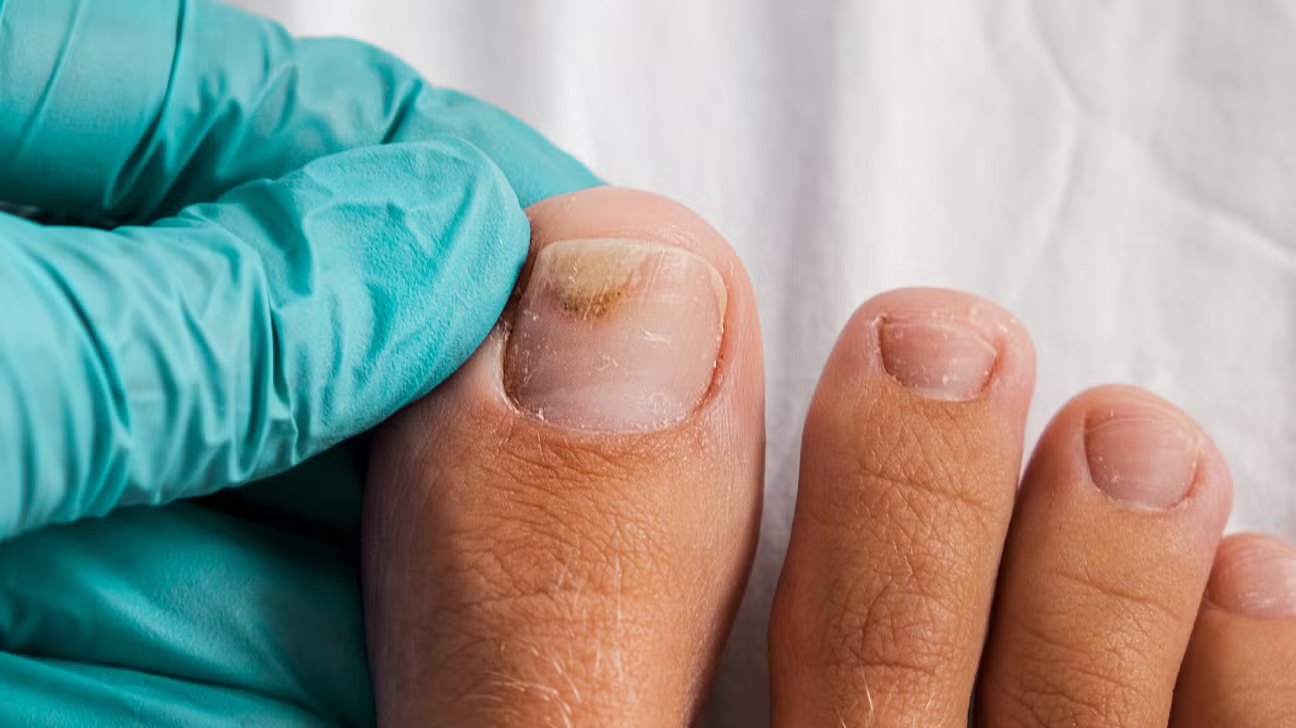
This blog is really about two very different foot conditions that can, at first glance, look alike. One is the humble ingrown toenail: common, painful, and almost always straightforward to treat. The other is malignant melanoma: rare on the feet, but deadly if it is missed.
The most famous example is Bob Marley. In the late 1970s he noticed a dark area beneath a toenail, which he believed was an old football injury. It was in fact a malignant melanoma. He declined the surgery that might have saved him, the cancer spread, and he died in 1981 at just 36 years old.
Bob Marley's Toe
The melanoma under Bob Marley's toenail was a type called acral lentiginous melanoma. It is rare, it is not caused by the sun, and because it hides in places we rarely look, such as the soles and under the nails, it is often found dangerously late.
The Patient I Begged to Go to A&E
I once had a patient who came to see me with a mark on her foot that I did not like the look of at all. She was due to fly to Switzerland the very next morning on business, and had every intention of going.
I begged her to go to A&E first. I told her I would stake my career on it. Thankfully, she listened.
A week later she telephoned me to say that I had saved her life. The lesion was an acral lentiginous melanoma, the same rare type as Bob Marley's, and surgery was an absolute necessity. It is the kind of phone call a podiatrist never forgets.
What Is Acral Lentiginous Melanoma?
Acral lentiginous melanoma is a form of skin cancer that appears on the palms of the hands, the soles of the feet, and underneath the finger and toenails. Unlike most melanomas, it is not linked to sun exposure, which means it can appear in areas that never see daylight.
It can affect anyone, of any skin tone. Because it turns up in hidden, unexpected places, and because people assume a dark mark under a nail is simply a bruise, it is frequently mistaken for something harmless and caught later than it should be.
Ingrown Toenail, or Something More?
A genuine ingrown toenail is usually easy to recognise. There is redness, swelling and pain along the edge of the nail, often with an obvious cause such as tight shoes or a nail cut too short, and it settles quickly with nail surgery at Grays Foot Clinic when needed.
A subungual melanoma, meaning a melanoma underneath the nail, behaves very differently. These are the warning signs that should never be ignored:
Do Not Assume It Is a Bruise
A bruise under a nail grows out and disappears over a few weeks as the nail grows. A dark streak or mark that stays put, widens, or spreads onto the surrounding skin is not a bruise, and it needs to be assessed by a professional without delay.
Warning Signs Under or Around a Nail
The ABCDE of Moles and Marks
For moles and pigmented marks anywhere on the feet, doctors use a simple checklist known as the ABCDE rule. If any of these apply, it is worth getting the mark checked:
The ABCDE Rule
Why I Check Every Mole
I always make a note of the moles on a patient's feet, and I ask whether they know each one is there. Most of the time they do. But you can never take the risk, because it only takes the one that nobody was watching.
The feet are the single most overlooked part of the body when it comes to checking the skin. As podiatrists, we routinely see the soles, the heels and the spaces between the toes, areas that patients cannot easily see themselves and that rarely get a second look anywhere else. That puts us in a genuinely important position to catch something early.
Check Your Own Feet
Once a month, take a proper look at your feet in good light: the soles, between the toes, and all of your nails. Use a mirror for the parts you cannot see, or ask someone to help. You are looking for anything new, dark, changing, or simply out of place.
If In Doubt, Get It Checked
If you notice a new, changing, dark or unusual mark anywhere on your foot or under a nail, do not wait and hope it goes away. See your GP, ask about a dermatology referral, or in an urgent case go to A&E, exactly as my patient did.
Caught early, melanoma is very often curable. Caught late, it is one of the most dangerous cancers there is. No podiatrist or doctor will ever think you are wasting their time by asking. As I told my patient, it is simply not a risk worth taking.
Trust Your Instincts
If something on your foot does not feel right, act on it. The worst that happens is that you are reassured. The best that happens is that, like my patient on her way to Switzerland, you catch something in time.
Our Service
Podiatry & Chiropody
Worried about a mole, a mark, or a dark nail? A thorough podiatry appointment includes a careful look at the skin and nails of your feet, the areas most often missed. If we see anything of concern, we make sure it is acted upon quickly. From £100.
GRAYS FOOT CLINIC
Ready for Expert Care?
HCPC-registered podiatrists in Holborn, London. Est. 1986.