I have always believed that we are all just one step away from becoming homeless. Think about it. If you lost your job and could no longer pay the mortgage, or missed only a few payments, how long would it really take? Storms, floods, fire and other catastrophes can take a home in an afternoon. And, as we all learned, so can a pandemic.
I have been a podiatrist for over forty years, and for most of that time I have felt a calling to help people who are in pain. But of all the work I have done in my career, including treating elite sportspeople, caring for the feet of the homeless is the work I am proudest of. It has given me far more than I could ever give back.
One Step Away
Homelessness is rarely a choice. A lost job, a missed mortgage payment, a sudden illness, a natural disaster or a pandemic can put almost anyone on the street. The people I treat are not a different kind of person. They are us, after a run of bad luck.
A Note on the Photographs
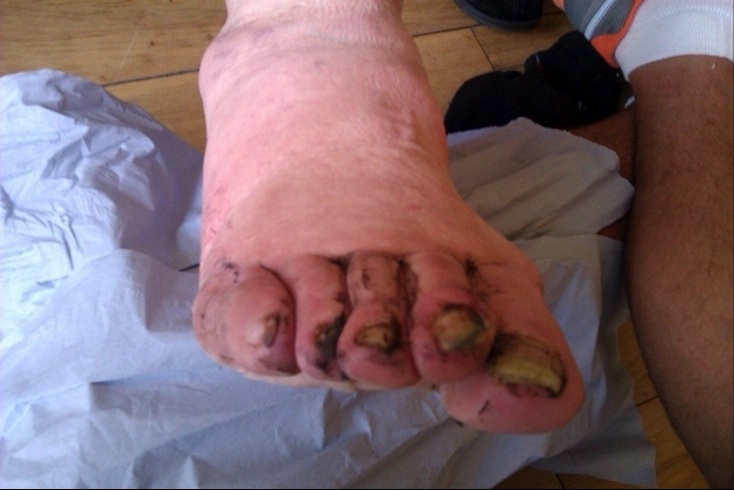
This article contains graphic clinical photographs of feet I have treated over the years, shown alongside the conditions they illustrate. Some readers may find them distressing.
How I Came to This Work
I started working with the homeless around thirty years ago, when I was with what was then Bloomsbury Health Authority. No other podiatrist wanted to take on this kind of work, so I simply fell into it, and I have been grateful ever since.
Around the same time I had a patient called Stan. If using fifty accumulated Tesco bags as a pillow, with no bedding, makes you homeless, then Stan was homeless. He had nobody to care for him: no family and no friends. He stayed with me a long time, and he is part of the reason I never looked away from this work again.
Arlington House
For five years I worked at Arlington House, a hostel for men in Camden Town, London. It was a real eye-opener, and I saw some shocking feet in those years. The conditions ranged from toenails that had grown straight through a sock, to maggots living quite happily in an ulcer between the toes of an elderly homeless man who was diabetic and did not know it.
Back in the 1980s we still had what people used to call real 'tramps' in the UK. These were men who wandered from city to city and slept in abandoned bus shelters and parks. Many had been on the streets for thirty years or more, and they carried the marks of it: frostbite and a kind of trench foot, the result of being exposed to extreme cold through one harsh winter after another.
A great many of the men I treated came from Irish or Scottish backgrounds. They had arrived in London in the 1950s and 60s to work as builders and road workers, but over the years many developed alcohol problems, or lived with mental health conditions that went undiagnosed and untreated, and eventually ended up living on the streets.
St Mungo's
Today I work with St Mungo's, a wonderful charity that genuinely cares for people who have experienced homelessness. Their whole ethos is rehabilitation: helping people back into work, into a home, and into a life that feels worth living again. It is a real privilege to play a small part in that.
What Foot Conditions Are Common Among the Homeless?
When you live outdoors, on your feet, in the same shoes and socks for weeks at a time, your feet take the brunt of it. These are the conditions I see most often.
Most Common Conditions I See
The Conditions That Can Cost a Limb
Ingrown toenails are common, and on the street they are dangerous. Left untreated, an infection can travel up the leg and lead to gangrene, to amputation, or at worst to septicaemia, which is blood poisoning.
Ulcers are just as serious. Some of the people I treat are living with diabetes mellitus, a condition in which blood sugar runs high because the body either does not produce enough insulin, or no longer responds properly to the insulin it makes. The classic signs are frequent urination, constant thirst and constant hunger. Being outdoors in all weathers makes ulcers far more likely, and if one becomes infected and is not treated with antibiotics, the same grim sequence can follow: gangrene, amputation and sepsis.
Why This Matters So Much
For someone with diabetes and reduced sensation in the feet, a small ulcer or an infected ingrown nail can become limb-threatening before they even feel any pain. This is why regular, free foot care for homeless people is not a luxury. It genuinely saves limbs, and it saves lives.
Skin, Nails and Infection
Corns, both hard and soft, are extremely common. Many of the men I have treated had sold their shoes, or wore footwear that was too tight or the wrong shape, and the constant friction builds corns, especially between the toes.
Nail dystrophies, meaning damaged and deformed nails, are almost the rule rather than the exception, particularly when socks and shoes are never changed. The feet also tend to harbour bacterial infections, simply because there is nowhere to wash, and fungal infections such as athlete's foot are everywhere, thanks to feet being shut inside the same shoes for very long periods. Athlete's foot is itchy and painful, and an underlying bacterial infection can take hold if it is left untreated.
Verrucae are less common but particularly awkward, because the acid treatments need rest afterwards, and someone who has to keep walking simply cannot rest.
The Smell, and How I Cope
Bromhidrosis, or badly smelling feet, affects almost every homeless patient I see, for the obvious reason that there is rarely anywhere to wash. How do I cope, people ask? Honestly, you get used to it. And I keep a bottle of my favourite aftershave to hand, which does a fine job of masking the worst of it.
Hyperhidrosis, or excessive sweating, is the other side of the same coin. Feet shut inside shoes for long stretches will sweat, blister and crack, and that can make walking genuinely difficult.
And then there is the one that has stayed with me: nails growing straight through socks. It is rare now, but I saw it often in the 1990s, simply because some men were unable to take their socks off for months at a time.
Why I Am Proud of This Work
I am enormously proud of the podiatry work I have done for the homeless, because it has given me humility, empathy and compassion. We are all, in the end, a mixture of circumstance and luck, both good and bad.
A Final Thought
If everyone did one good deed every day, the world would be a kinder place. Caring for someone's feet, really caring, is a small thing that can give a person back a little of their dignity. That is why I keep doing it.
Our Service
Podiatry & Chiropody
Whether your feet have been neglected for weeks or for years, our HCPC-registered podiatrists treat ulcers, infections, corns and neglected nails with care and without judgement. From £100.
GRAYS FOOT CLINIC
Ready for Expert Care?
HCPC-registered podiatrists in Holborn, London. Est. 1986.